Poverty Truth Commission

Nothing about us, without us, is for us!
What is a Poverty Truth Commission (PTC)?
It begins with putting people’s direct experiences of poverty at the center of the discussion; asking them to set the agenda for change and what needs to be done to bring it about. It provides the spaces to build a deep, relational connection between those who make decisions and those who are most affected by them. A PTC seeks to humanise the current systems and structures, and all of those within it; moving beyond labels of ‘professional’ and ‘service user’, ‘us’ and ‘them’ toward a more equitable place of a ‘bigger us’, where all voices are listened to and heard. It is not just about creating a new policy, process or work stream but perhaps more importantly about rebalancing power in community.
Why now?
It was recognised that in Warrington, although there were some examples of excellent partnership working, the expertise and wisdom of residents in decision making was not consistently and methodically embedded in decision making. Influenced by the successes other areas had seen with and through the process it was believed that a Poverty Truth Commission could catalyse a much needed shift in coproduction, culture and system change now and into the future, that recognises the essential part that communities have to play in deciding, designing and delivering solutions to the issues they are most affected by.
Why WVA?
Warrington Voluntary Action were recommended by the Poverty Action Group to be put forward to host the Warrington PTC, due to being the local infrastructure charity, having strong connections across a breadth of community organisations as well as with statutory partners within local authority and health.
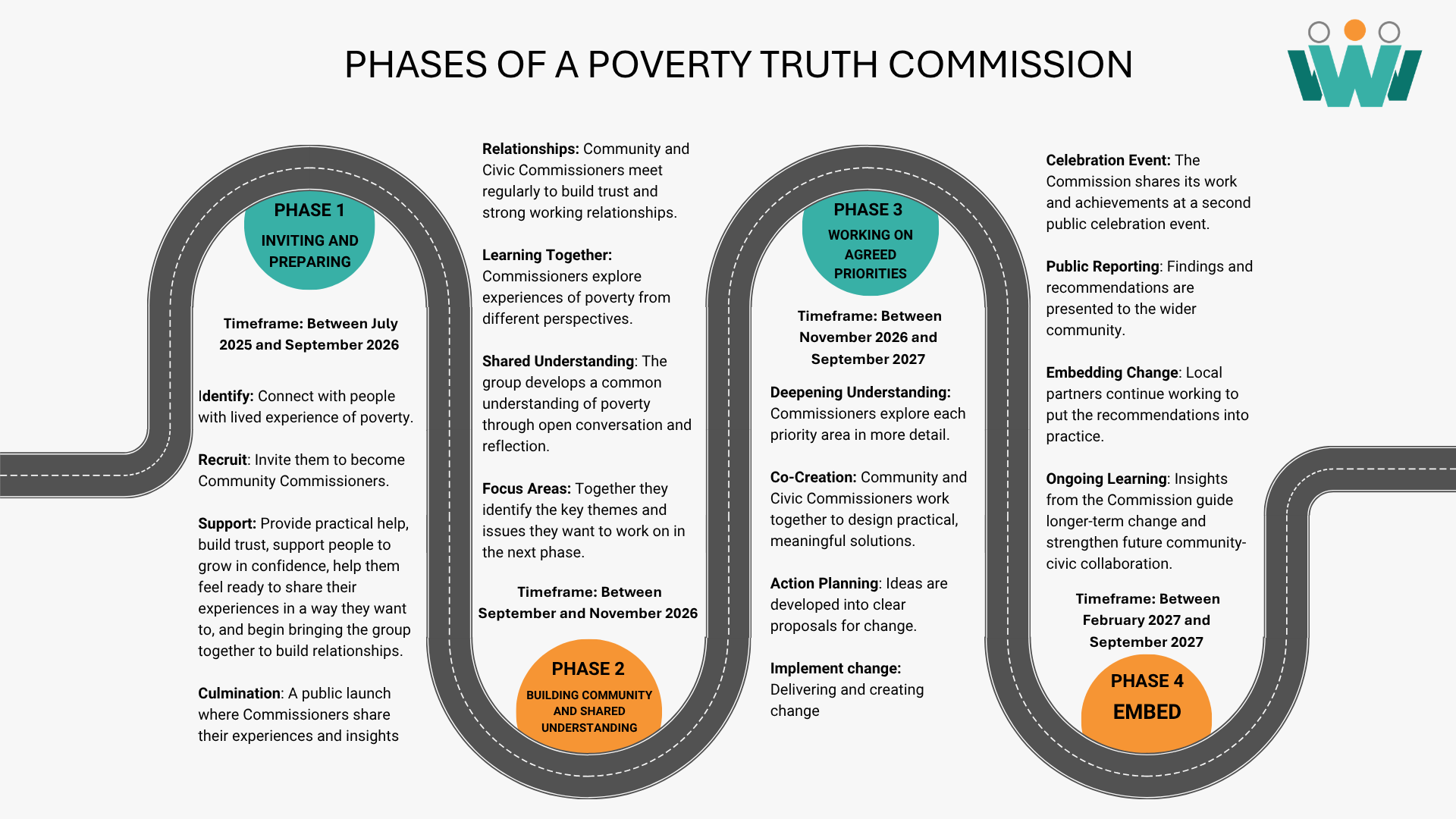
Phases of a PTC
Phase ONE - Inviting & Preparing
Timeframe: Between July 2025 and September 2026
Identify: Connect with people with lived experience of poverty.
Recruit: Invite them to become Community Commissioners.
Support: Provide practical help, build trust, support people to grow in confidence, help them feel ready to share their experiences in a way they want to, and begin bringing the group together to build relationships.
Culmination: A public launch where Commissioners share their experiences and insights
Phase TWO - Building Community & Shared Understanding
Timeframe: Between September and November 2026
Relationships: Community and Civic Commissioners meet regularly to build trust and strong working relationships.
Learning Together: Commissioners explore experiences of poverty from different perspectives.
Shared Understanding: The group develops a common understanding of poverty through open conversation and reflection.
Focus Areas: Together they identify the key themes and issues they want to work on in the next phase.
Phase THREE - Working on Agreed Priorities
Timeframe: Between November 2026 and September 2027
Deepening Understanding: Commissioners explore each priority area in more detail.
Co-Creation: Community and Civic Commissioners work together to design practical, meaningful solutions.
Action Planning: Ideas are developed into clear proposals for change.
Implement change: Delivering and creating change
Phase FOUR - Embed
Timeframe: Between February 2027 and September 2027
Celebration Event: The Commission shares its work and achievements at a second public celebration event.
Public Reporting: Findings and recommendations are presented to the wider community.
Embedding Change: Local partners continue working to put the recommendations into practice.
Ongoing Learning: Insights from the Commission guide longer-term change and strengthen future community-civic collaboration.